No products in the cart.
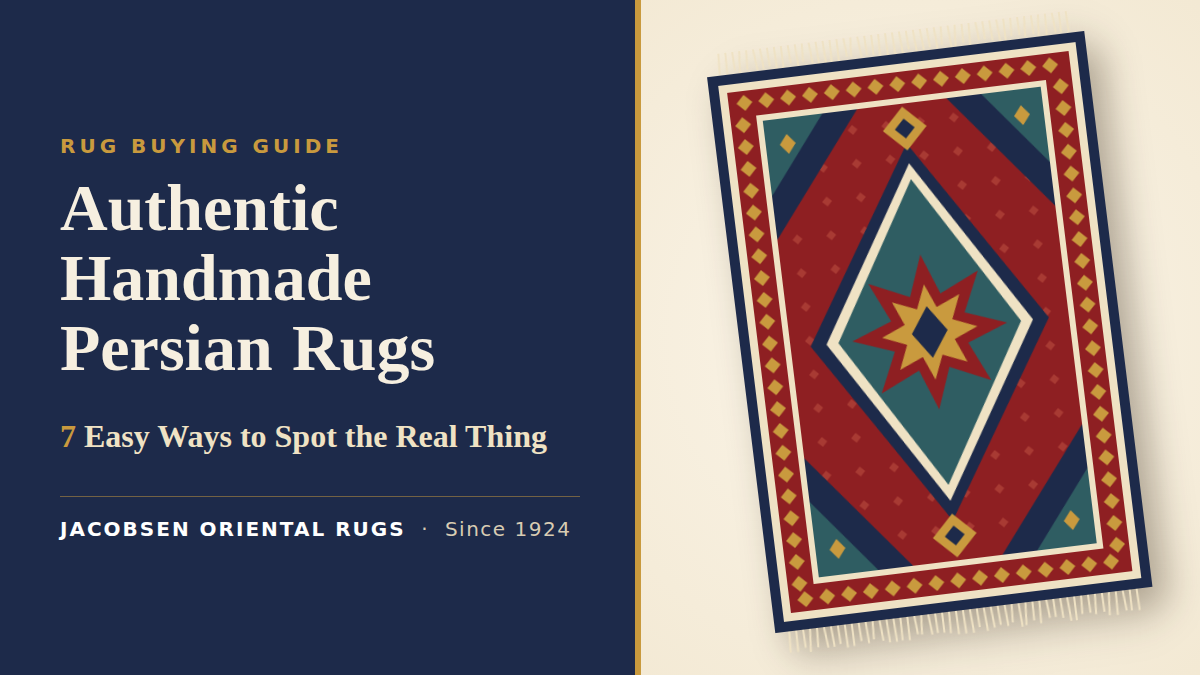

Here’s something that happens to a lot of people. You’re shopping for authentic handmade Persian rugs, and you find two that look almost exactly alike. Same red and blue colors. Same pretty pattern. But one is $300 and the other is $3,000.
So what’s going on? Is the expensive one a rip-off? Is the cheap one a great deal? Or is one of them not what it says it is?
Don’t worry. You don’t need to know a lot about rugs to figure this out. We’ve been selling hand-knotted rugs since 1924, and we’re going to share the same easy checks we use every day. By the end of this guide, you’ll be able to walk into any store and spot the real thing.
First, a little bit of history.
A true Persian rug comes from Iran, a country that used to be called Persia. People there have been making rugs by hand for thousands of years. Every town has its own style, and many patterns have been handed down from parents to kids for hundreds of years.
These days, you’ll also see a lot of rugs called “Persian-style.” They have the same classic look, but they’re made in other countries, like India, Pakistan or Turkey. And here’s something many people don’t know: lots of them are made by hand too, by talented weavers using the very same old ways. They can be every bit as beautiful, and they can last just as long.
So here’s the main thing to remember. Whether a rug comes from Iran or somewhere else, the most important question is: was it made by hand? Authentic handmade Persian rugs, and rugs made the same way, are tied by hand, one tiny knot at a time. Rugs made in a factory are not.
| Handmade (Hand-Knotted) | Machine-Made | |
|---|---|---|
| How it’s made | A person ties every knot by hand | A big machine weaves it |
| How long it takes | Months, sometimes more than a year | A few hours |
| What it’s made of | Usually wool or silk | Often nylon, polyester (types of plastic) or a mix |
| The back of the rug | You can clearly see the pattern | Blurry, or covered with a cloth backing |
| The fringe | Part of the rug itself | Usually sewn or glued on |
| How long it lasts | Decades, often generations | Usually a few years |
| Value over time | Can keep or even grow its value | Goes down fast |
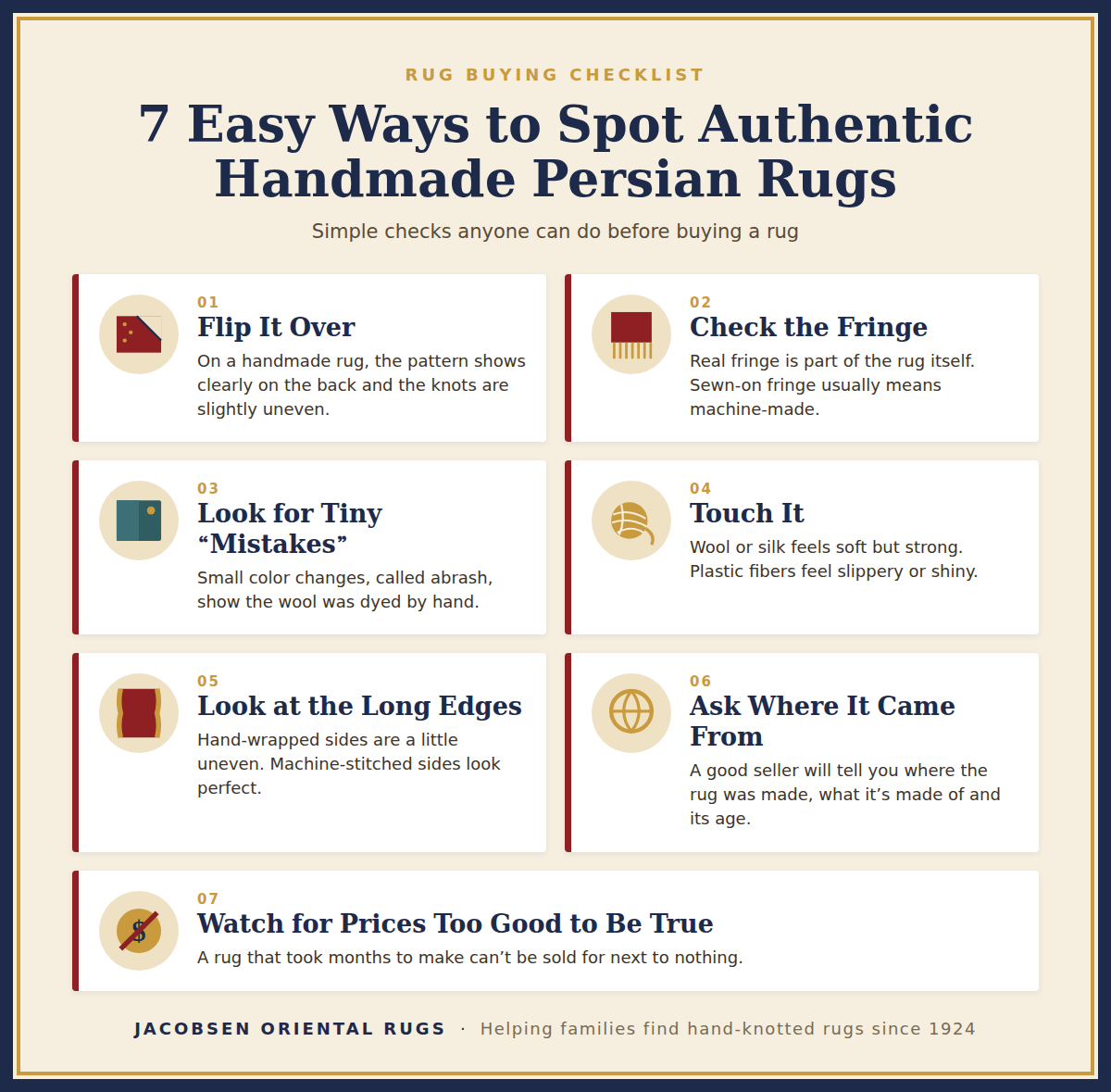
If you only remember one tip, make it this one. Just turn a corner of the rug over and take a look.
On a handmade rug, the back looks a lot like the front. You can see the whole pattern clearly. Look a little closer and you’ll notice the knots aren’t all exactly the same size. That’s what happens when a real person makes something with their hands.
Here’s a bonus tip: the more knots you can count in one square inch, the better and more detailed the rug usually is.
On a machine-made rug, the back looks too neat, almost like graph paper. And on a cheaper “tufted” rug (a rug made by shooting yarn into a backing with a tool), the back is usually covered with a piece of cloth, so you can’t see anything at all.
The fringe is the row of strings at each end of the rug. On authentic handmade Persian rugs, the fringe isn’t added on later. It’s actually the ends of the long threads the whole rug was made on.
Try this: pick up one strand of fringe and follow it with your eyes. If it runs straight into the rug, that’s a great sign. If the fringe is sewn on as a separate strip, the rug was almost certainly made by a machine.
This might sound strange, but little flaws are a good thing. Handmade rugs are never perfect. You might notice:
That color change even has a name: “abrash.” It happens because the wool is dyed by hand in small batches, and each batch comes out a tiny bit different. People who love rugs actually look for it. It’s like a little note that says, “a person made this.”
Run your hand across the top of the rug. Authentic handmade Persian rugs are usually made from wool, silk, or a mix of both. Good wool feels soft but strong, with a little natural bounce to it.
Rugs made from plastic materials feel different. They’re often slippery, shiny or a bit “fake” to the touch. If it feels more like a fuzzy blanket than a rug, be careful.
Now check the two long sides of the rug. On a handmade rug, they’re usually wrapped by hand with wool, so they might be a little bumpy or uneven.
On a machine-made rug, the sides are stitched by a machine. They look super tight, super straight and exactly the same from one end to the other.
A good seller should know their rugs. Ask where it was made, what it’s made of and about how old it is. You should get a clear, honest answer. If the seller isn’t sure or quickly changes the subject, that’s a warning sign.
One more thing worth knowing: because of US trade rules, new rugs from Iran have been hard to bring into America for years. So many Persian rugs you’ll find in the US are older pieces, and many new ones are Persian-style rugs made in other countries. Neither one is “fake.” What matters is that the seller tells you the truth about it.
Think about it this way. A big handmade rug can take a weaver many months to finish. That much work simply can’t be sold for the price of a pizza dinner.
So if you see “authentic handmade Persian rugs” being sold online for next to nothing, be careful. It might be machine-made. It might be damaged. Or it might just not be what the ad says it is.
Ever wonder why one rug costs so much more than another? It usually comes down to five things:
Once you know you’re looking at authentic handmade Persian rugs, the fun part begins: finding the one that feels right in your home. Here are a few easy tips:
You can also browse all our hand-knotted rugs online. They come in standard sizes, and if your room needs something special, we can have a rug made to fit.
Authentic handmade Persian rugs are made to last a very long time. They just need a little care:
When it’s time for a proper deep clean, our team offers professional rug cleaning and repair for handmade, vintage and oriental rugs.
The easiest way to make sure you’re getting authentic handmade Persian rugs, or Persian-style rugs made the same way, is to buy from people who have been doing this for a long time.
Jacobsen Oriental Rugs has been helping families find handmade rugs for over 100 years. Our founder, Jake Jacobsen, loved rugs so much he wrote four books about them. You can read his story on our About Us page.
Still have questions? Check out our rug FAQs, or get in touch any time. Even better, stop by our Syracuse or Saratoga Springs showroom. We’ll happily flip over as many rugs as you want. Honestly, it’s one of our favorite things to do.
Flip the rug over. If you can clearly see the pattern on the back, the knots look slightly uneven, and the fringe runs right into the rug, it’s very likely handmade.
Are Persian-style rugs from India or Pakistan fake?
Not at all. Many are hand-knotted the same traditional way and are very well made. A true Persian rug comes from Iran, so a good seller will simply tell you where each rug was made.
What does “abrash” mean?
Abrash is the gentle color change you sometimes see across a handmade rug. It happens because the wool is dyed by hand in small batches. It’s a sign the rug was made by a person, not a machine.
Why do authentic handmade Persian rugs cost so much?
Because a large one can take months to make by hand, using natural wool or silk. The size, number of knots, material, age and where it was made all affect the price.
How long will a handmade Persian rug last?
With a little regular care, a good handmade rug can last for decades. Many get handed down from parents to kids, and then to grandkids.


Leave a comment